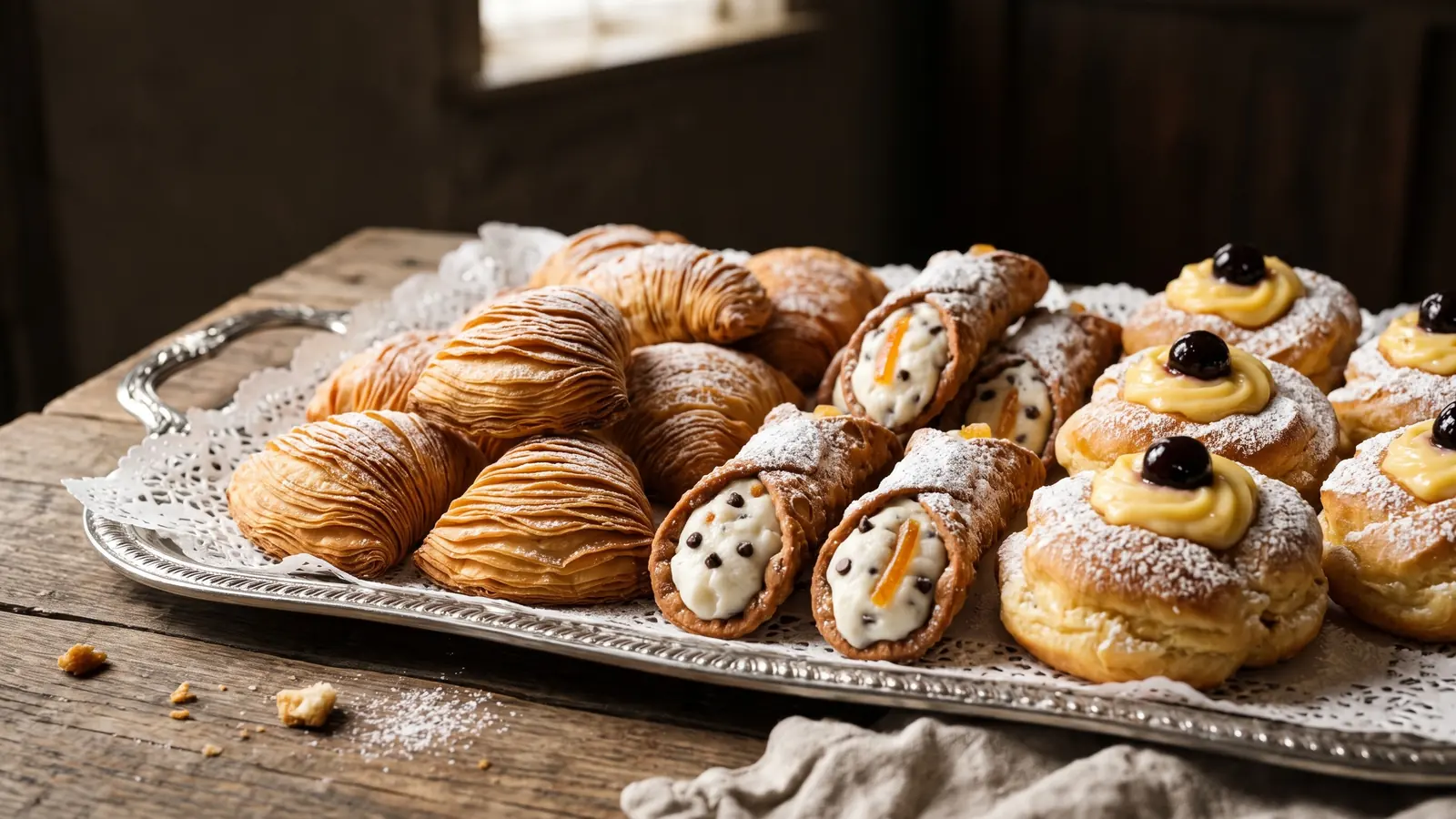
Short answer
Sfogliatelle are shell-shaped pastries from Campania in southern Italy. Dozens of thin dough layers bake into a crisp, ridged shell around a sweet filling of ricotta, semolina and candied citrus. The plural is sfogliatelle and one pastry is a sfogliatella.
Sfogliatelle are shell-shaped Italian pastries from Naples and the Campania region, made of many paper-thin dough layers that bake into a crisp, ridged shell. Inside sits a sweet filling of ricotta, semolina and candied citrus. The singular is sfogliatella, and the name comes from the Italian word for a thin leaf or sheet of pastry.
What are sfogliatelle?
Sfogliatelle are a traditional pastry of southern Italy, built from thin sheets of dough rolled, stretched and layered until the baked shell looks like a fan of overlapping petals. The name relates to sfoglia, the Italian word for a thin sheet of dough.
The pastry is closely linked with Naples and the wider region of Campania, and it is also found in Italian bakeries across North America. The filling is a sweet, slightly grainy paste, and the shell is the star: crisp at the edges, tender toward the centre.
Sfogliatelle are sometimes called Neapolitan pastries or “Italian clamshells” in English because of the shape. They belong to the same family of laminated and layered pastries as puff pastry and phyllo, though the dough and method are their own.
How do you say sfogliatelle?
The word is pronounced sfohl-ya-TEL-leh, with the stress on the third syllable. One pastry is a sfogliatella, said sfohl-ya-TEL-la.
The tricky part is the middle of the word, spelled gli. In Italian this sound is close to the “lli” in the English word million. English speakers usually manage a clear version by saying sfohl-yah-TEL-leh, and bakers and customers will understand it.
What are sfogliatelle made of?
A sfogliatella is made from a stretched wheat dough, a fat to separate the layers, and a filling of ricotta, cooked semolina, sugar and candied citrus peel, often with a touch of cinnamon.
| Part | What it contains | Role |
|---|---|---|
| Shell | Flour, water, fat, salt | Forms the crisp layers |
| Filling | Ricotta, semolina, sugar | Gives a creamy, slightly grainy centre |
| Flavourings | Candied orange or citron peel, cinnamon, sometimes vanilla | Adds a gentle citrus and spice note |
| Finish | Icing sugar | Sweet dusting on top |
Recipes differ by bakery and by family. Some versions add egg, some use more citrus and some are sweeter. The fat used to separate the layers varies too, so anyone with a dietary need should ask the bakery what goes into the dough.
What is the difference between sfogliatelle riccia and frolla?
Sfogliatelle riccia are the curly, many-layered type, while sfogliatelle frolla have a smooth shortcrust-style shell. The filling is usually similar in both.
- Riccia means curly. The dough is stretched very thin, rolled into a log, sliced and shaped into a shell, so the baked pastry shows many fine crisp ridges. This is the version most people picture.
- Frolla means shortcrust. The shell is a smooth, tender pastry, closer to a small filled tart, with no visible layers.
Riccia is crisper and more delicate and tends to shatter when you bite it. Frolla is softer and holds together better. If you are choosing for the first time, riccia gives the classic experience.
Where do sfogliatelle come from?
Sfogliatelle come from Campania, and a commonly told story places their invention in a convent on the Amalfi Coast, with the pastry later becoming a Naples favourite in the nineteenth century. The exact details are not firmly documented.
The tale usually names a convent near Conca dei Marini, where nuns are said to have first made a pastry from leftover semolina cooked with milk, sugar and dried fruit. A Neapolitan pastry maker is then said to have refined the recipe and sold it in the city. Food historians treat the story as tradition rather than proven fact, so it is best told as a story.
What is not disputed is that sfogliatelle are firmly part of Neapolitan baking and that they travelled with Italian emigrants, which is why a bakery in Ontario can sell them today.
How do you eat a sfogliatella?
Eat a sfogliatella with your hands, ideally fresh and slightly warm, and expect flakes to fall. Bite from the pointed side and let the filling come through with each mouthful.
Practical tips:
- Eat it over a plate or napkin, because the crisp layers shed crumbs.
- Do not cut it with a knife, which crushes the ridges.
- Pair it with coffee, espresso or tea, which suit the sweet filling.
- If it is a day old, warm it for a few minutes in a hot oven to bring back some crispness.
A sfogliatella is usually eaten at breakfast or as an afternoon sweet, and it is often a weekend purchase from an Italian bakery.
Why are sfogliatelle hard to make at home?
Sfogliatelle are hard to make at home because the dough has to be stretched extremely thin and rolled tightly, and the shell has to be shaped by hand while the layers stay separate.
Home bakers often use a simplified method with store-bought dough or a rolled pasta sheet. These shortcuts can give a good result, though the ridges are rarely as fine as a professional shell. A dedicated pastry bakery handles the stretching and shaping daily, which is a main reason people buy sfogliatelle instead of baking them.
Are sfogliatelle the same as a lobster tail?
No. A lobster tail is an Italian-American relative of the sfogliatella that uses a similar layered dough but is larger, longer and usually filled with whipped cream or custard.
| Sfogliatella | Lobster tail | |
|---|---|---|
| Size | Small, palm-sized | Larger, longer |
| Filling | Ricotta, semolina, candied citrus | Whipped cream or custard |
| Origin | Campania, Italy | Italian-American bakeries |
| Texture | Crisp shell, dense filling | Crisp shell, soft cream |
Some people use the two names loosely, so it helps to look at the filling when you order.
Does Cordi Italian Bakery sell sfogliatelle?
Directory listings of Cordi Italian Bakery in Mississauga, Ontario name sfogliatelle among the pastries the bakery is reported to sell, and a 2013 blog review also mentions them. Cordi has no official website or published menu, so this guide cannot confirm what is on the shelves today.
The sfogliatelle appear on this site’s menu page as a directory-sourced item, with no price, because no current price was found. Stock changes through the day, so a call to the bakery on (905) 629-1243 is the way to check before a trip. The hours and location page lists the address and the opening hours as recorded on 2026-11-14.
Common questions
How do you pronounce sfogliatelle?
Say it as sfohl-ya-TEL-leh, with the stress on TEL. The singular is sfogliatella, said sfohl-ya-TEL-la. The sfogl sound is close to the English word folio with an s in front.
Are sfogliatelle served warm or cold?
Both are common. Many people prefer them warm from the oven, when the layers are at their crispest. They are also eaten at room temperature, and a short reheat in a hot oven revives a day-old pastry.
What is the difference between sfogliatelle riccia and frolla?
Riccia, meaning curly, has many thin crisp layers and a ridged shell. Frolla, meaning shortcrust, has a smooth, tender pastry shell like a small tart. Both usually hold the same style of sweet ricotta filling.
Is a lobster tail the same as a sfogliatella?
Not exactly. A lobster tail is an Italian-American pastry that uses a similar layered dough but is larger and usually filled with whipped cream or custard. A sfogliatella is smaller and holds a ricotta and semolina filling.
How long do sfogliatelle stay crisp?
They are best the day they are baked. Kept loosely covered at room temperature, they stay acceptable for a day or two, but the layers soften. A few minutes in a hot oven restores some crispness.
For the address, opening hours and menu, see Cordi Italian Bakery in Mississauga.
This article is general information from an independent guide, not from Cordi Italian Bakery itself. For the store’s current details see hours and location.